
Strategy
·10th July 2026
·5 min read
Multifunctional Skincare: The Real Cost of Doing Everything
The single product asked to do several jobs at once has become skincare’s defining brief, and the hardest to build well. The reason is an engineering one.
Nadia Zarrouk
Coseer Co-founder and Cosmetic Engineering Consultant
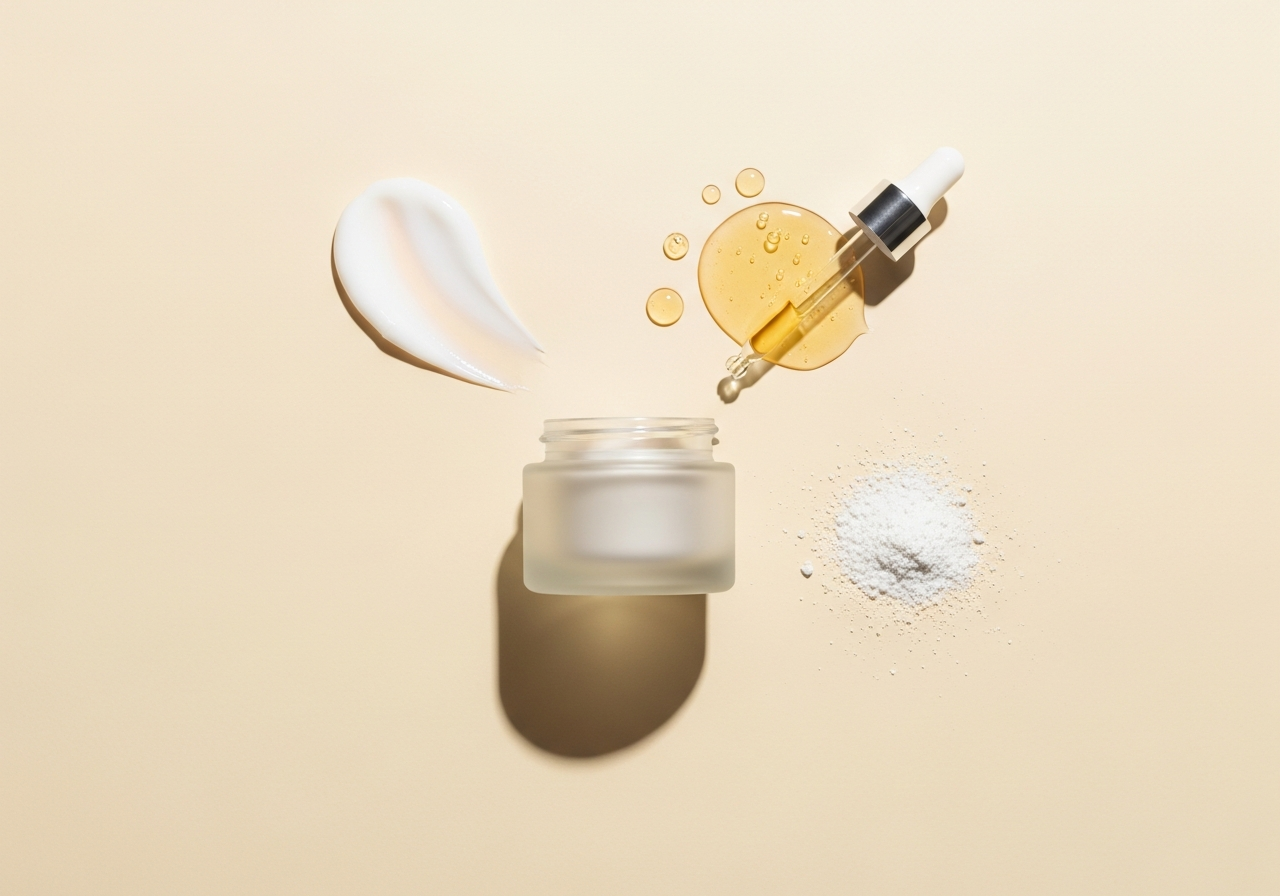
Ask a founder what they want to build and increasingly the answer is one product that does everything. A moisturiser that also brightens and shields against the sun, a serum that hydrates, firms and calms in one step. The multifunctional product, one formula asked to do the work of several, is the defining brief of the moment.
Its appeal is self-evident: more value in one bottle, a simpler ritual, one purchase where there were once three. It can deliver that but only when the founder understands precisely what they are asking the formula to do, because within a single product every added function competes for the same, finite space.
The pull toward one product that does more
The multifunctional brief is the meeting of two forces: a customer who wants fewer steps, and an industry that has learned to load more proven actives into every formula. The trade calls the wider movement skinification; within skincare it becomes steady pressure on each product to do more than one thing.
- In the UK, Mintel reports that 29% of women have moved to multifunctional products as they spend less time on longer routines, and that a third of men buying skincare say a product’s ability to do more than one thing shapes what they choose. Source: Mintel, via CEW UK
The pattern reaches beyond the UK: Euromonitor’s 2025 skin-health analysis finds brands worldwide concentrating on multi-benefit products, with moisturisers that carry SPF among the clearest examples.
The instinct is to answer that appetite by asking one product to carry as many benefits as it can. That is where the engineering begins and where most multifunctional briefs quietly lose their way.
One product, one budget
Every formula is built within a fixed budget. Not only of cost, but a technical one: a limited allowance of actives, a limited tolerance for how many can coexist before it turns unstable, a narrow band of acidity, a finite margin of texture before the feel on the skin suffers. A product devoted to one outcome spends that budget in a single direction; one asked to achieve three must divide it three ways.
This is what a brief rarely acknowledges. To ask a moisturiser to brighten, to shield against the sun and to plump is not to add three benefits to a working cream; it is to divide one formula’s capacity across four ambitions, each new active drawing room from those already at work. What results is a product that contains, on paper, everything its label promises and delivers none of it with conviction.
The moisturiser that does everything
Consider a familiar brief: a daily moisturiser that hydrates, brightens and carries sun protection. Three benefits, one step, one bottle. Each is reasonable alone; together they contend for the same ground. Sun protection needs a high, even load of UV filters that claims much of the formula at once. Brightening actives such as vitamin C need a low, acidic environment, while those filters, and the light feel expected of a daily cream, prefer their own. Push the formula one way and the brightening weakens; the other, and the protection or texture gives way.
None of this makes the product impossible; it means the three ambitions cannot all be honoured at full strength at once. One must lead, the others yield. The decision carries regulatory weight too: under EU Regulation (EC) 1223/2009 every claim, SPF included, must be independently substantiated, so each function adds its own burden of proof. Made deliberately, before a laboratory is briefed, that choice separates a product that persuades from one that disappoints on every promise.
To combine is not to dilute
A strong multifunctional product and a weak one may begin from the same idea; what separates them is hierarchy. The credible ones decide early which function the product leads with, the one it delivers without compromise, and which merely support it, engineered to sit alongside without drawing budget away. The weaker ones lead with everything, which is to lead with nothing: the budget spreads evenly, each benefit arrives at half its strength, and the product is capable in several respects and convincing in none.
The ambition is no fault; a product that genuinely performs two roles well is a real advantage, harder for a competitor to copy. The fault lies in treating “does everything” as a list of features rather than a set of trade-offs to be resolved on purpose.
The Coseer perspective
At Coseer, a multifunctional brief is a question of priority long before it is a question of ingredients. Before any laboratory is engaged, we establish with the founder what the product leads with, what it supports and what it deliberately declines to attempt, so the formulation’s budget is spent by intention. This is the work of a feasibility review and of ingredient direction: to determine early whether the combination can hold together in one formula, and to name the trade-offs it will demand.
Done well, a product that performs several functions at once can become one of the most distinctive in a brand’s range, but only when the decisions behind it are made before formulation begins, not discovered, at cost, once it is underway.
A product that sets out to do everything, without first deciding what it does, will do nothing its customer remembers.
Building a product that has to do more than one thing? A feasibility review defines what it should lead with before a formula is briefed.
Related Articles

Strategy
10th June 2026
·4 min read
A Trend Is Not a Product Brief
How skincare ideas are translated into structured, buildable product decisions, before formulation begins.
Read Article →
Strategy
10th March 2026
·6 min read
Before You Brief a Lab: Why Skincare Feasibility Reviews Matter
A focused review of a product concept identifies major gaps and inconsistencies before laboratory development begins.
Read Article →